HFSS compliant or nutrient-dense: why the NPM 2018 finally rewards both
If your team has been running product development with one eye on the HFSS threshold and the other on nutrient density claims, you'll know those two goals can pull in opposite directions. Boost protein to earn a health story. Add dates for sweetness and fibre. Watch the sugar score climb.
That tension has been a real formulation constraint for years. The NPM 2018, published by DHSC in January 2026, starts to resolve it. But only if you understand where the model actually changed, and where it didn't.
What NPM 2004 got wrong, and what NPM 2018 fixes
The current model used in HFSS regulation is the 2004/05 NPM, developed by the Food Standards Agency for Ofcom. It scores products on a points basis: negative "A points" for energy, saturated fat, total sugars, and sodium; positive "C points" for fruit, vegetables and nuts (FVNS), fibre, and protein. Foods scoring 4 or more are classed as HFSS. Drinks at 1 or more.
The core structure hasn't changed in NPM 2018. But two things have.
Free sugars replace total sugars. Under the 2004 model, all sugars scored equally. Under NPM 2018, only free sugars attract A points, so sugars naturally present in whole fruit and dairy don't penalise your score in the same way. What does penalise you: added sugars, fruit juice, honey, purées. The threshold for the first point kicks in at 0.9g free sugars per 100g. A fruit-and-nut cereal bar sweetened partly with Medjool date paste will still accumulate free sugar points even if it looks clean label. Date paste counts.
Fibre scoring doubles. Under NPM 2004, fibre can contribute a maximum of 5 C points. Under NPM 2018, that ceiling doubles to 10. The thresholds align with the EU nutrition claims framework: 5 points at 3g fibre per 100g (the "source of fibre" level), 10 points at 6g per 100g ("high fibre"). The model now uses AOAC fibre only, so any fibre data from older lab reports or on-pack declarations using NSP methodology won't give you the right number.
Protein scoring remains capped at 5 C points, and the protein cap rule is unchanged: if a product's A score reaches 11 or more, protein points are excluded entirely from the C score. That cap matters for high-sugar protein products. It's where a lot of the "health halo" concern lives.
The categories this hits hardest
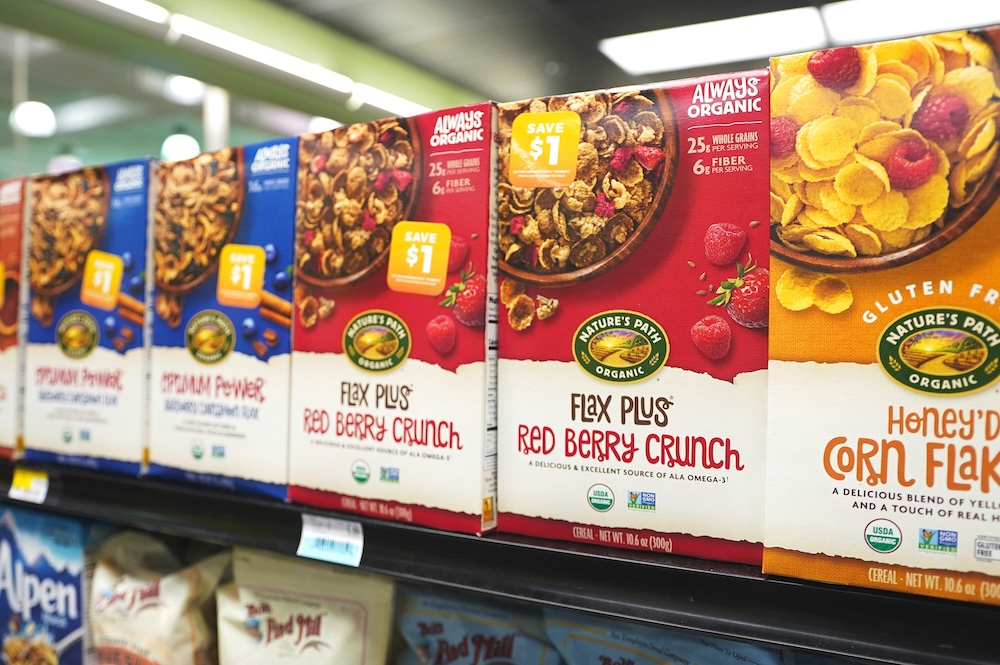
Breakfast cereals and dairy-based products come out worst in the retail dataset analyses. British Nutrition Foundation analysis found lower overall pass rates under NPM 2018 for these categories specifically. Products built around the 2004 model, using added sugar and protein together to land on or just under the threshold, now face a double hit. Their free sugar score may be higher than their total sugar score implied. And if they cross the A=11 threshold, their protein C points disappear entirely.
Kellogg's Bran Flakes is a widely-cited example: previously non-HFSS, newly HFSS under NPM 2018 because of the shift to free sugars. Plain oats come out better than before.
For drinks, the direction is stricter overall. Fruit juices and smoothies that benefited from being scored as whole-fruit FVNS under the 2004 model now face tighter treatment, because naturally-occurring sugars in juice are classified as free sugars. The drinks category is expected to see the most significant reclassification overall.
What this means if you're reformulating right now
The 2004 NPM still applies legally. As of June 2026, the HFSS advertising restrictions that came into force on 5 January 2026 (The Advertising (Less Healthy Food Definitions and Exemptions) Regulations 2024), and the placement and promotions rules in England under The Food (Promotion and Placement) (England) Regulations 2021, are both still referenced to the 2004 NPM. A public consultation on adopting NPM 2018 for these regulations is expected in 2026, with no confirmed date yet.
So you are not immediately out of compliance if you pass the 2004 model today.
But if you're in active NPD or reformulation, building against the 2004 model and ignoring NPM 2018 is a short-sighted strategy. Products launching this year will still be on shelves in 2027 and 2028, when NPM 2018 is likely to be the operative model. The 10-Year Health Plan, published in July 2025, described the 2004 model as "plainly out of date" and estimated that adopting NPM 2018 could reduce adult obesity cases by nearly 170,000. That direction of travel is firm.
The practical framework:
Run dual scores. Model every new product against both NPM 2004 and NPM 2018 during development. It takes minutes with the right tool and tells you immediately whether you're building something that will need reformulating again in 18 months.
Audit your free sugars properly. This is the step most teams are skipping. Free sugars are not the same as total sugars on your nutrition label. They need to be calculated from recipe, using the DHSC free sugars decision tree, because they don't appear as a separate line in standard nutrition declarations. If you're using dates, honey, agave, fruit concentrates, or fruit juice in any form, those sugars are free sugars.
Take fibre seriously as a formulation tool. The new 10-point fibre ceiling is the most significant positive change in NPM 2018. A product that moves from 2g to 5g fibre per 100g could gain 5 extra C points. Ingredients worth modelling: chicory root inulin and FOS, pea fibre, oat beta-glucan, apple fibre.
Each one comes with functional trade-offs. Inulin is a useful illustration. Short-chain inulin (oligofructose) has a sweetness value of around 30-35% that of sucrose, which can help offset sugar reduction. But at higher inclusions, the sensory picture gets complicated. In a pea protein-based vegan ice cream, 2-4% inulin improved texture and meltdown resistance. At 6-8%, flavour acceptability dropped noticeably. In baked products, inulin can reduce loaf expansion and increase crumb density at levels that would push you into "source of fibre" territory. Long-chain inulin forms fat-mimicking gels above 10-20%, which is useful in some matrices and a problem in others. The point is: hitting 3g or 6g fibre per 100g through inulin addition isn't a one-ingredient fix. It's a formulation decision that affects texture, mouthfeel, and in some cases water activity. Beta-glucan adds viscosity in liquid systems. Pea fibre has a slightly beany background note in neutral products. Apple fibre is cleaner sensorially but contributes less per gram in C-point terms at typical inclusion levels.
None of this means fibre isn't the right lever. It means the route to 5 or 10 C points needs trialling, not assuming.
Don't over-invest in protein to clear the threshold. The protein cap at A=11 is unchanged. If your product has high free sugars and you're trying to offset with protein, you may be building something that passes the 2004 model but fails NPM 2018. The fibre route is more durable.
The broader shift the NPM 2018 signals
There's a legitimate question in the food industry about whether compliance-driven reformulation and genuine nutrient density are aligned goals. For years, they haven't fully been.
The 2004 model allowed some products to be "non-HFSS" while being nutritionally thin, clearing the threshold by stacking protein points against sugar without being foods that would register as particularly nourishing. As Nesta noted after the January 2026 publication, the tightened free sugar thresholds make it much harder to offset the impact of free sugars through protein alone.
NPM 2018 doesn't resolve the binary problem. A product is still either HFSS or not, which ignores the difference between a product scoring 3 and one scoring -5. But the shift to free sugars and the stronger fibre weighting means the model is harder to game with narrow reformulation strategies. You can't clear NPM 2018 on protein alone. You can't hide behind a total sugar number when your recipe is full of date paste.
For food teams working on genuinely nutritious products (real fibre, controlled added sugar, honest protein claims), NPM 2018 is a more favourable landscape than NPM 2004 was. The trade-off between being HFSS compliant and nutrient-dense is closing.
What to do now
Run dual NPM scores on your current range. Identify which products will flip HFSS status under NPM 2018 before the consultation starts. You want to know before, not after.
Calculate free sugars properly for any product that uses fruit, honey, syrups, or concentrates. Don't assume your total sugars number is close enough.
Model fibre uplift scenarios on products that are currently borderline. The doubled C-point ceiling makes fibre the most valuable reformulation lever in NPM 2018, but test the sensory impact alongside the score.
Document everything. The consultation on adopting NPM 2018 will involve industry response. Companies that have already modelled their range and can evidence reformulation progress will be in a stronger position.
Frequently asked questions
What is the difference between NPM 2004 and NPM 2018?
The NPM 2018 replaces total sugars with free sugars in the negative "A points" calculation, increases the maximum fibre C points from 5 to 10, uses AOAC fibre methodology only, replaces sodium with salt, and includes seeds alongside fruit, vegetables and nuts. The core structure (scoring per 100g, with food classed as HFSS at a score of 4 or more) is unchanged. The updated model was published by DHSC on 27 January 2026 but is not yet applied to policy.
Is NPM 2018 in force now?
No. As of June 2026, current HFSS regulations in England still apply the 2004/05 NPM. The Government published the NPM 2018 in January 2026, and a public consultation on applying it to advertising and promotions restrictions is expected in 2026. The 2004 model remains the legal reference for both The Advertising (Less Healthy Food Definitions and Exemptions) Regulations 2024 and The Food (Promotion and Placement) (England) Regulations 2021.
What are free sugars, and how do I calculate them for my HFSS score?
Free sugars include all added sugars in any form, plus sugars naturally present in fruit juice, smoothies, purées, and syrups. They do not include sugars in whole fruit, vegetables, or milk. Free sugars are not declared separately on UK nutrition labels; they need to be calculated from your recipe using the DHSC decision tree. Fruit juice concentrates, date paste, honey, agave, and similar ingredients all contribute free sugars, even if a product is marketed as "no added sugar."
Will my HFSS-compliant product still pass under NPM 2018?
Possibly not. British Nutrition Foundation analysis of retail datasets found lower overall pass rates under NPM 2018, with the biggest impact on breakfast cereals and dairy-based foods. Products that used high protein to offset added sugar under NPM 2004 are most at risk, because the protein cap at A=11 remains unchanged while the free sugar threshold is tighter. Run a dual-model check against your current formulation before the consultation begins.
How does fibre help an HFSS score under NPM 2018?
Under NPM 2018, fibre can contribute up to 10 C points, doubled from 5 under NPM 2004. The scale is: 5 points at 3g AOAC fibre per 100g, 10 points at 6g per 100g. Moving a product from below 3g to above 3g fibre per 100g adds 5 C points to its score, equivalent to eliminating 5 A points of negative nutrients. That makes fibre the most valuable single reformulation lever for improving an NPM 2018 score, though each fibre ingredient carries its own sensory and functional trade-offs at the inclusions needed to reach those thresholds.
How do I calculate my HFSS score?
The NPM score is calculated per 100g. Add up A points for energy (kJ), saturated fat, free sugars (NPM 2018) or total sugars (NPM 2004), and salt (or sodium). Deduct C points for FVNS content, fibre, and protein. If the final score is 4 or more for food (1 or more for drinks), the product is HFSS. The DHSC published NPM 2018 technical guidance in January 2026 alongside the updated model document.